AI Quiz Generator
Generate quizzes from any text, PDF, image, URL, or YouTube video in under a minute. Free AI quiz generator. No signup for quiz-takers. Multiple choice, true/false, and short answer questions with explanations.
Free account, no credit card. 5 free generations per month.
Try it now — no account needed
Type a topic and get two real questions from the same AI that writes full quizzes. Sign up free to get the whole quiz.
Popular exams in United States
Type a topic above to unlock quiz generation
Smart AI
Trained on educational content. Calibrates difficulty to Bloom's levels, not just keyword density.
Fast
10-question quiz in 10–30 seconds. Long PDF (50 pages) in under 90 seconds.
Customizable
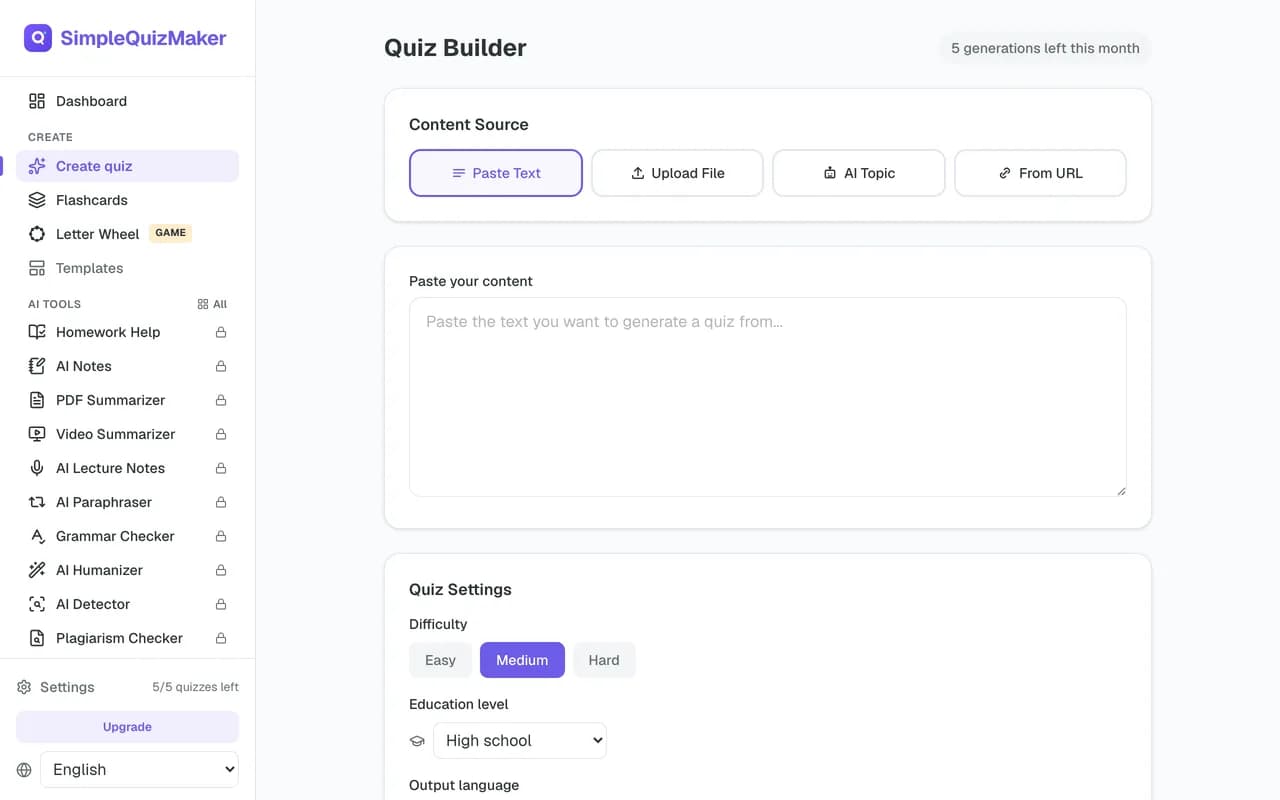
Difficulty, question count, format mix, audience level — all configurable.
How the AI quiz generator works
When you submit content, the generator runs three steps. First, it extracts the source — OCR for images, transcript parsing for YouTube, content extraction for URLs, direct read for text and PDF. Second, it identifies key concepts, facts, and relationships in the source — what the generated questions should test. Third, it produces stems, answer choices (including plausible distractors), correct-answer marking, and explanations.
Under the hood, we use a large language model (GPT-class) with a custom system prompt that constrains the AI to source-grounded questions, calibrated distractor difficulty, and pedagogically-meaningful explanations. The full system prompt is documented at AI Quiz Prompt Engineering for Teachers.
Six source formats — any content becomes a quiz
The generator handles the six most-requested source formats. Click any tile below to jump to that workflow:
Plain Text
Paste lecture notes, textbook excerpts, articles, or any text directly into the topic box.
PDF Documents
Upload course PDFs, lecture notes or research papers. The AI extracts the text and structures questions around it (one upload a month free, more on paid plans).
Images (OCR)
Photograph a textbook page, a whiteboard, or handwritten notes. OCR extracts the text; the AI generates the quiz.
YouTube Videos
Paste any YouTube URL. We pull the transcript and generate a quiz on the lecture or tutorial content.
Website URLs
Paste any public article URL. We fetch the content, clean it, and generate a quiz scoped to the article.
Topic Names
Just type a topic ("Krebs cycle", "French Revolution causes"). The AI generates a quiz from general knowledge.
Question types
The AI generates four question types, mixable in a single quiz:
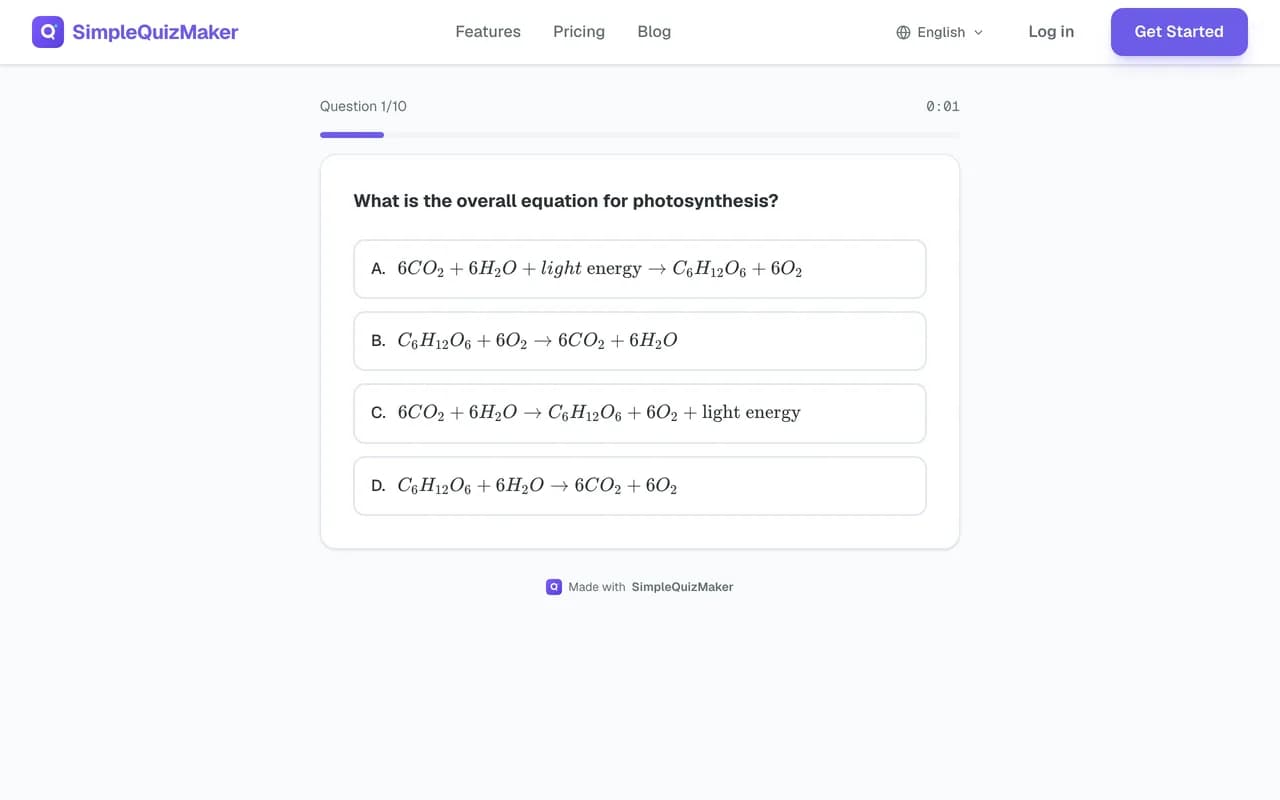
- · Multiple choice — 4 answer options, one correct. Best for assessment at scale.
- · True or false — fast warm-up. Use sparingly (50% guess rate).
- · Fill in the blank — strong recall practice.
- · Short answer — for diagnostic / formative use.
Looking for BuzzFeed-style outcome quizzes instead of graded assessment? See personality quiz maker.
Difficulty levels — calibrated to Bloom's taxonomy
The three difficulty levels map to Bloom's taxonomy levels:
- · Easy — Bloom's 1–2 (Remember, Understand). Tests recall and basic comprehension.
- · Medium — Bloom's 3 (Apply). Tests transferring concepts to new situations.
- · Hard — Bloom's 4 (Analyse). Tests comparing, contrasting, breaking down concepts.
Calibrating difficulty is the single biggest determinant of whether a quiz teaches or just measures. Match the difficulty to the cognitive level you want to test — see how to write good quiz questions for the framework.
Use cases
The AI quiz generator gets used most often for:
Teachers — classroom assessment
Generate a weekly chapter quiz from textbook PDFs. Generate exit tickets from today's lesson notes. Build a quiz bank for the entire year in a Saturday morning. See SimpleQuizMaker for teachers.
Students — self-study and test prep
Generate practice quizzes from your own lecture notes. Drill active recall — the highest-leverage study technique. Use for NCLEX, USMLE, SAT, GRE, AP, certification prep. See SimpleQuizMaker for students, or a step-by-step walkthrough at quiz maker for studying.
Corporate trainers — onboarding and compliance
Generate compliance training quizzes from internal SOPs. Build role-specific onboarding knowledge checks. See SimpleQuizMaker for business.
Content creators — engagement and segmentation
Generate personality quizzes for newsletters and social media. Generate trivia quizzes for pub nights and family game nights. Drive shares with viral quiz formats.
A real quiz on a hard setting — and where it falls short
We typed only the topic “The French Revolution” and chose 8 questions, hard difficulty, multiple choice, true/false, short answer. Generated on 2026-10-21 with the free plan's model. Nothing below has been edited — including the parts we would fix.
Multiple choice
1. What was the main cause of the French Revolution?
- Economic inequality (correct answer)
- Technological advancements
- Colonial expansion
- Religious conflicts
Economic inequality between the social classes, particularly the burden of taxes on the Third Estate, was a primary cause of the French Revolution. The other options do not adequately address the root issues that led to the uprising.
Multiple choice
2. The Declaration of the Rights of Man and of the Citizen was adopted in which year?
- 1789 (correct answer)
- 1791
- 1793
- 1799
The Declaration was adopted in 1789, marking a pivotal moment in the revolution by establishing individual and collective rights. The other years listed are significant but do not correspond to the adoption of this document.
True / false
3. True or False: The French Revolution led to the establishment of a constitutional monarchy.
- True (correct answer)
- False
Initially, the French Revolution did establish a constitutional monarchy, particularly after the formation of the Constitutional Assembly in 1789. However, this was short-lived as the revolution progressed.
Multiple choice
4. Which of the following groups was primarily responsible for the radical phase of the French Revolution?
- The Girondins
- The Jacobins (correct answer)
- The Sans-culottes
- The Royalists
The Jacobins were the leading group during the radical phase of the French Revolution, advocating for more extreme measures. The other groups either supported more moderate reforms or were opposed to the revolution.
Short answer
5. Short Answer: What was the name of the period of political turmoil following the revolution, characterized by the Reign of Terror?
Answer key: The Terror
The period known as 'The Terror' was marked by extreme political repression and mass executions, primarily during 1793-1794.
Multiple choice
6. How did the French Revolution influence other countries in Europe?
- It led to the rise of monarchies
- It inspired revolutionary movements (correct answer)
- It caused economic decline
- It isolated France from Europe
The ideals of the French Revolution, such as liberty and equality, inspired numerous revolutionary movements across Europe and beyond. The other options do not accurately reflect the widespread impact of the revolution.
True / false
7. True or False: The Napoleonic Wars were directly a result of the French Revolution.
- True (correct answer)
- False
The Napoleonic Wars were indeed a direct result of the French Revolution, as they stemmed from the revolutionary changes in France and the expansionist policies of Napoleon Bonaparte.
Multiple choice
8. What was the primary goal of the Committee of Public Safety during the French Revolution?
- To promote economic stability
- To defend the revolution from its enemies (correct answer)
- To establish peace with monarchies
- To create a new constitution
The Committee of Public Safety was created to protect the revolution from internal and external threats, leading to significant actions including the Reign of Terror. The other options do not capture the committee's defensive purpose.
What we would change before sharing it
- Question 1: "The main cause" has no single right answer; historians weigh the fiscal crisis, inequality and Enlightenment ideas together. Ask which factor the class reading stressed, or turn it into a short answer.
- Question 2: Not wrong, but this is a recall question on a "hard" setting. Hard mode on a broad topic name still produced several easy questions; give the generator your own reading for harder ones.
- Question 4: The sans-culottes also drove the radical phase, so two options are defensible. Rephrase around the Jacobin club specifically.
- Question 5: The Terror happened during the Revolution (1793–94), not "following" it, and the question gives away the answer by naming the Reign of Terror. Rewrite it.
5 of the 8 questions were ready to use as written. That is why every quiz opens in an editor before you share it.
What it looks like
How AI quiz generation compares to writing quizzes by hand
| Dimension | Hand-written | AI-generated |
|---|---|---|
| Time per 10 questions | 45–90 minutes | 10–30 seconds |
| Distractor quality | High (teacher knows misconceptions) | Good but sometimes too easy — needs editing |
| Answer-key accuracy | Near 100% | Usually right on well-documented topics — always verify, especially negative-phrased items |
| Variety | Limited by teacher fatigue | Unlimited variations |
| Customisation post-draft | N/A (already custom) | Full edit access on every question |
The pattern that works in practice: let the AI draft the quiz, then spend a few minutes refining the questions that need polish. You get the speed of AI with the quality of hand-written.
Limitations — what AI quiz generation cannot do
Be honest about the limits. AI quiz generators are not a replacement for teacher judgement on:
- · High-stakes proctored exams. AI-generated practice questions are valuable; the actual high-stakes exam should still be hand-vetted.
- · Subjective interpretation. Literature analysis, philosophy, ethics — the AI produces reasonable questions but with answers that may need teacher curation.
- · Cutting-edge content. AI training data has a cutoff. Recent research, current events, post-2024 medical guidelines all need verification.
- · Mathematical proofs and multi-step calculations. Verify the math by hand on quantitative questions.
- · Negative-phrased questions. “Which of the following is NOT…” is the most common answer-key error class.
See Best AI quiz generators (2026) for a deeper comparison of AI quiz tools and their tradeoffs.
Frequently asked questions
Is SimpleQuizMaker's AI quiz generator free?
Yes. 5 free generations per month with up to 10 questions per quiz. Paid plans start at $1.99/month and raise the limit to 15–80 AI generations per month and up to 50–100 questions per quiz.
What can I generate from?
Plain text, PDF, image, YouTube video, website URL, or just a topic name.
How accurate is it?
Usually correct on well-documented topics. Always verify answer keys before sharing, especially on negative-phrased questions.
Can I edit AI-generated questions?
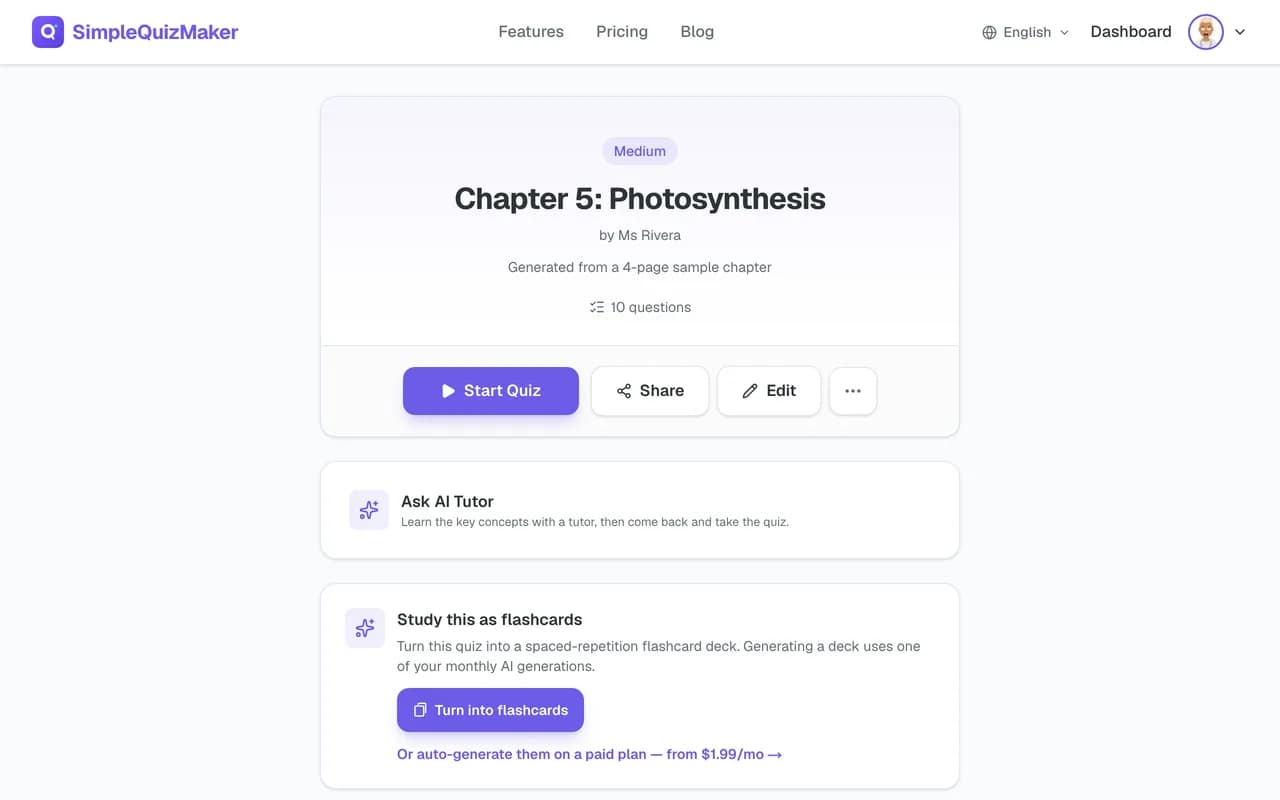
Yes. Every question is editable: rewrite it, change the answer choices or delete it before you share. If the whole set misses the mark, regenerate it.
Is using AI to make quizzes cheating?
Not when used as a productivity tool to draft assessments. The pedagogical question is whether the resulting quiz tests what you actually want students to learn. See our discussion.
Ready to generate your first AI quiz?
5 free generations per month. No signup for quiz-takers.
Start Generating — FreeRelated guides
- · How AI quiz generators work (under the hood)
- · Best AI for making quizzes (2026 comparison)
- · AI quiz prompt engineering — 12 templates
- · ChatGPT vs Claude for teachers
- · Can ChatGPT make quizzes?
- · Is using AI to make quizzes cheating?
- · Designing assessments AI can't cheat
- · How to make a quiz, step by step